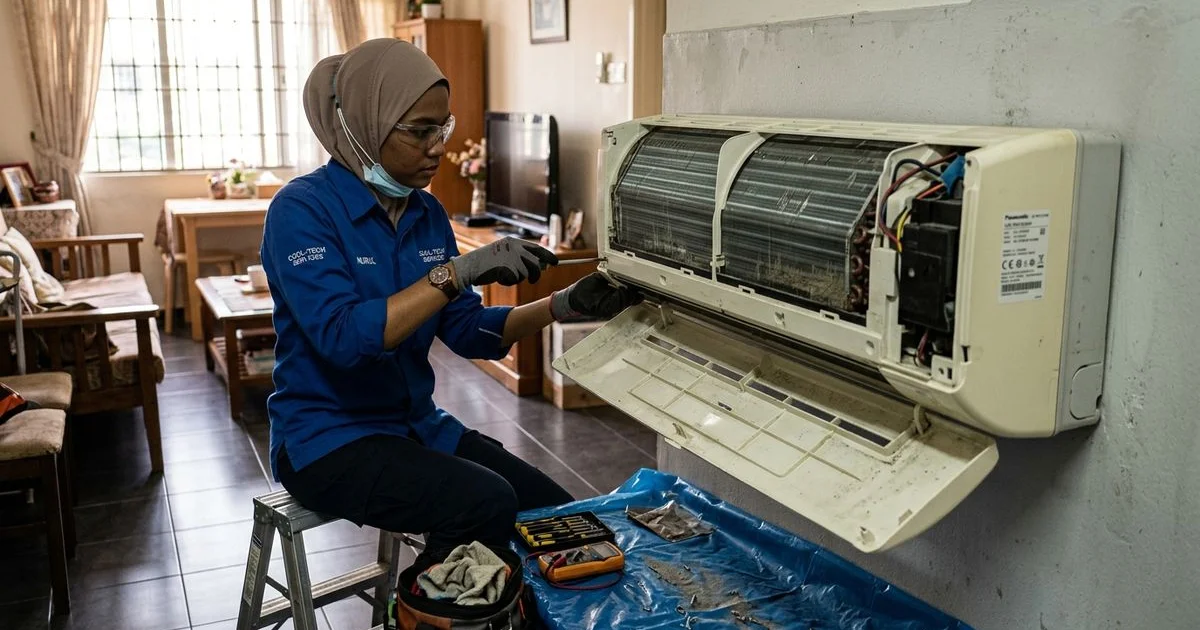
We see a recurring pattern during service calls across Petaling Jaya. A homeowner asks for a standard gas top-up, completely unaware that their specific cooling system requires a highly specialised chemical. That missing detail frequently leads to massive compressor failures, which is why our aircond service in Petaling Jaya team always checks the refrigerant type on the unit’s data plate before quoting any work.
Answering the question of R22 vs R410A vs R32: Which Aircond Gas Does Your Unit Use? is the first step to protecting your investment.
Our team knows from experience that you cannot just swap these chemicals around. Each one operates at a completely different pressure level and requires a specific type of compressor oil.
We frequently repair the severe damage caused by incompatible setups. The data tells a clear story about why identifying your refrigerant matters. Let us look at the facts, what they mean for your electricity bills, and how to respond when your unit stops blowing cold air.
R22 vs R410A vs R32: Which Aircond Gas Does Your Unit Use?
Refrigerant is the vital chemical compound that absorbs heat inside your house and releases it outside. It circulates in a sealed loop between the indoor evaporator coils and the outdoor condenser. The substance changes from liquid to gas and back as it transfers heat.
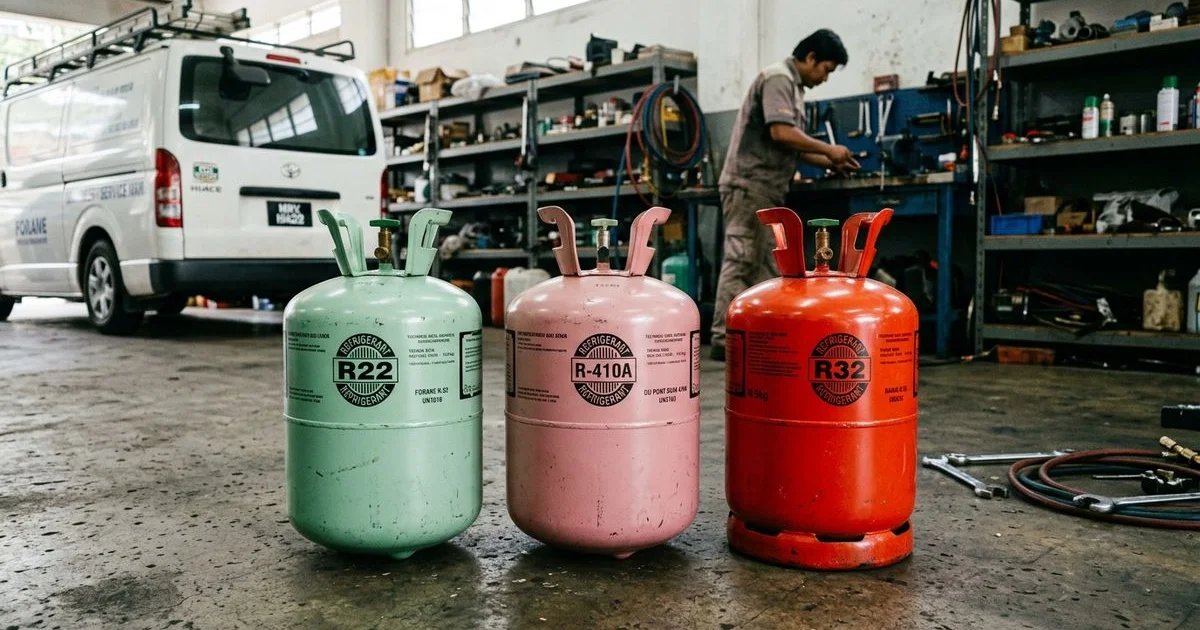
Our industry relies on three main types for Malaysian residential setups. The three most common refrigerants are R22, R410A, and R32. They are absolutely not interchangeable.
Here is a quick breakdown of why these gases cannot be mixed:
- Different Operating Pressures: R410A operates at a pressure roughly 50 to 70 percent higher than R22.
- Incompatible Lubrication Oils: R22 systems use mineral oil to lubricate the compressor.
- Synthetic Oil Requirements: R410A and R32 require synthetic polyolester (POE) oil.
We strongly warn against mixing these oils. Doing so creates a thick sludge that will quickly destroy your compressor.
| Refrigerant | Usage Era | Global Warming Potential (GWP) | 2026 Top-Up Cost (PJ) |
|---|---|---|---|
| R22 | Pre-2015 | 1,810 (High) | RM80 to RM160 |
| R410A | 2010 to 2018 | 2,088 (Very High) | RM100 to RM180 |
| R32 | 2018 to Present | 675 (Low) | RM130 to RM180 |
R22 (Older Units - Phased Out)
Hydrochlorofluorocarbon (HCFC) refrigerant was the original standard for residential aircond units from the 1990s through the early 2010s. If your aircond is over ten years old and has not been retrofitted, it is almost certainly R22.
Our government is actively phasing this chemical out under the Montreal Protocol. The Department of Environment (DOE) Malaysia’s HCFC Phase-Out Management Plan (HPMP) Stage III aims for a complete ban by 2030. Strict import quotas are already restricting the supply across the country.
Here is what you need to know about keeping an R22 unit today:
- Environmental Impact: Very high, with an ozone depletion potential of 0.055.
- Current Top-Up Costs: Expect to pay RM80 to RM160 in Petaling Jaya for a standard top-up.
- Replacement Strategy: If the unit requires major repairs, upgrading to a new R32 inverter unit will often pay for itself through lower electricity consumption.
R410A (2010-2018 Units)
The industry introduced this hydrofluorocarbon (HFC) blend as the direct replacement for R22. Most inverter and non-inverter aircond models installed in Malaysia between 2010 and 2018 utilise this gas. Your Daikin, Panasonic, or Acson inverter from that era is very likely an R410A unit.
Our technicians find that R410A operates at a significantly higher pressure than older systems. You must never let a technician tell you they can just top up R410A as a substitute for R22. The pressures are entirely incompatible and your compressor will fail almost immediately.
Key facts about your R410A system:
- Environmental Impact: It causes zero ozone damage but holds a massive GWP of 2,088.
- Current Top-Up Costs: The pricing sits right in the middle range, costing between RM100 and RM180.
- Future Outlook: The industry is currently phasing out R410A in favour of much greener alternatives.
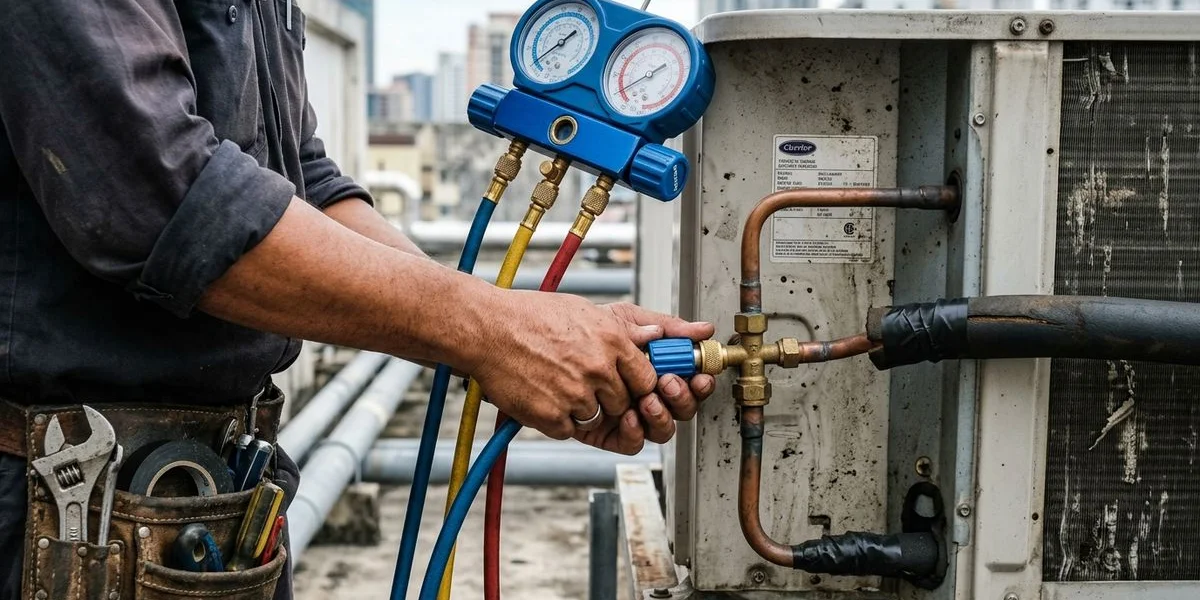
R32 (Current Standard - 2018+)
This single-component HFC refrigerant serves as the modern eco-friendly replacement for R410A. All new aircond models sold in Malaysia since 2018 use this standard. Major brands like Daikin, Panasonic, Acson, Midea, and York now ship R32-exclusive units.
Our recent installations show massive efficiency gains with this modern gas. A 2024 study on Malaysian air conditioners highlighted that variable-speed R32 units can reduce greenhouse gas emissions by up to 63 percent compared to older fixed-speed models. Clients frequently report noticeable drops in their monthly electricity bills.
The primary benefits of the R32 standard include:
- Environmental Impact: The GWP is 675, which is about one-third the impact of both older gases.
- Energy Efficiency: These systems require about 20 percent less refrigerant mass to do the exact same cooling work.
- Current Top-Up Costs: A standard top-up typically ranges from RM130 to RM180 depending on the horsepower.
How to Identify Which Gas Your Unit Uses
The quickest way to check your chemical type is to look at the nameplate sticker. You will usually find this metal plate or durable sticker on the side of the outdoor condenser unit. Look for a specific line that says “Refrigerant” or “R-Type” to identify the exact gas.
We know that these stickers sometimes fade or peel off over time. Exposure to the hot Malaysian sun can make the text completely unreadable.
If you cannot read the outdoor label, you have a few other options to verify the gas type:
- The indoor unit cover: Some brands print the refrigerant type directly on the front panel.
- Your purchase receipt: The user manual and the original invoice will always list the exact refrigerant type.
- The age of the unit: Pre-2010 models are almost always R22, while 2010 to 2018 models are usually R410A.
Our support team is always ready to assist if you feel unsure. Send a photo of your unit on WhatsApp and the technicians will identify it for you.
Why You Shouldn’t Keep Topping Up Gas
Here is an important fact that many customers miss about their cooling systems. Refrigerant does not simply run out in a healthy air conditioning unit. The gas circulates in a completely sealed loop.
If your unit is low on gas, you definitely have a leak somewhere in the system. Common signs include a hissing sound near the indoor unit or thick ice forming on the evaporator coils. Topping up the gas without finding that leak is just throwing your money away.
Our standard gas top-up service always includes a comprehensive system check. A proper repair fixes the underlying leak and prevents repeat visits.
Here is the exact five-step process a professional should follow:
- Pressure test: The technician checks the current operating pressure against the manufacturer specifications.
- Leak detection: We apply a bubble test or an electronic sniffer on all suspected areas.
- Minor leak repair: The technician solders small pinhole leaks on the copper piping where possible.
- Vacuum process: The system must be evacuated to remove moisture before recharging.
- Proper gas charge: We add the new refrigerant to the exact spec using a precision digital scale.
If a cheap technician just attaches a gauge, adds some gas, and leaves, you will be calling them back in two months.
Free Gas Top-Up with Chemical Wash (Save RM80-250)
Here is an excellent deal available in the Petaling Jaya aircond servicing market right now. Every chemical wash from AC Service Pro PJ includes up to 10kg of refrigerant top-up at no extra cost. This provides a complete recharge for a typical 1.5 to 2.5HP residential unit at zero additional fee.
We highly recommend combining these services for maximum value. Routine maintenance extends the life of your cooling system and keeps your indoor air healthy.
If your unit is due for a chemical wash AND low on gas, book the chemical wash. You will save the RM80 to RM250 gas fee and get a deep clean as a fantastic bonus. Learn more about our chemical wash service or our standalone gas top-up service.
Conclusion
Understanding R22 vs R410A vs R32: Which Aircond Gas Does Your Unit Use? is crucial for your home maintenance strategy.
Picking the correct chemical saves you from expensive compressor replacements and sky-high electricity bills. We are ready to help you optimise your home cooling system today.
Send a message to schedule your next service. WhatsApp 016-636 6769 with your unit’s HP rating, brand, age, and current symptoms. The service team will recommend the right solution and provide a fixed price quote within 24 hours.